

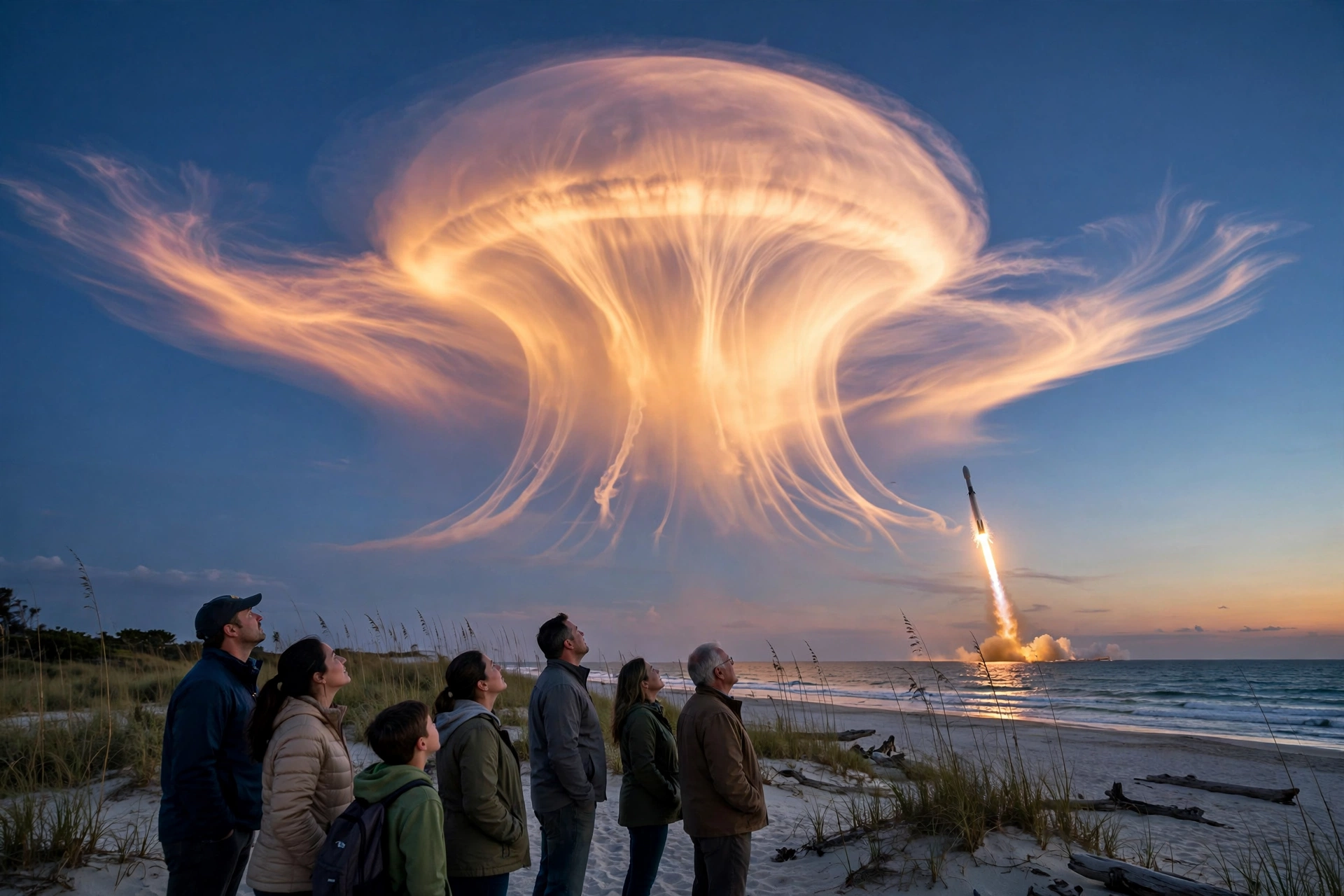
Early risers along the US East Coast were treated to an unusual sight in the sky this week when a SpaceX rocket launch created a glowing, jellyfish-shaped cloud high above the Atlantic. The luminous formation, photographed from beaches, backyards and city rooftops, spread quickly across social media as people tried to work out what they were looking at. It was not a storm, a comet or anything mysterious. It was sunlight catching a rocket plume at exactly the right moment, and the effect was spectacular.
What People Saw in the Sky
Witnesses described a bright point of light rising through the pre-dawn or twilight sky, followed by an expanding plume that fanned out into translucent, tentacle-like trails. Within minutes the cloud appeared to bloom, glowing white, blue and pale orange against the still-dark sky below it. Reports and photographs of the phenomenon were covered by The Guardian, which noted how widely the striking images were shared along the coast.
For many viewers, the surprise was part of the appeal. Rocket launches are now routine events for the space industry, but most happen in full daylight or deep darkness, when exhaust plumes are either washed out by sunshine or barely visible at all. A launch timed close to sunrise or sunset is different. The rocket climbs out of the Earth’s shadow while the ground below is still dim, and the plume suddenly catches full sunlight. The result looks less like machinery and more like a luminous sea creature drifting across the sky.
Why the Jellyfish Shape Forms
The so-called jellyfish effect is a well understood piece of atmospheric physics. As a rocket gains altitude, the air around it becomes thinner, so its exhaust plume is no longer held in a narrow stream. Instead, the gases expand outward dramatically, forming the rounded "head" of the jellyfish. The thinner, trailing streams behind it become the tentacles. Because the plume is so high, sunlight illuminates it long before, or long after, the same light reaches observers on the ground.
Upper-atmosphere winds then stretch and twist the expanding gases, which is why no two jellyfish clouds look exactly alike. Some appear as neat, symmetrical fans. Others smear into long, curling ribbons that can linger for many minutes before dispersing. Photographers prize these launches precisely because the outcome is unpredictable: the same rocket, on a different morning, can produce a completely different picture.
A Reminder of How Busy Orbit Has Become
The sight is also a sign of the times. Launches from Florida’s Space Coast have become so frequent that residents who once planned their week around a single liftoff now see rockets as a regular part of the landscape. Commercial crews, cargo missions and large satellite deployments share the same launch pads, and agencies such as NASA routinely publish schedules, mission details and viewing guidance for the public.
That growing cadence has a scientific side too. The same coastline that watches rockets rise also follows ambitious ocean science, as our recent coverage of scientists racing to map the deep ocean floor before 2030 explains. Between the seafloor and low Earth orbit, the region has become a front-row seat for some of the most ambitious exploration projects of the decade.
How to Catch the Next One
Skywatchers hoping to see a jellyfish cloud for themselves should look for launches scheduled in the hour before sunrise or just after sunset, when the contrast between the dark ground sky and the sunlit plume is strongest. Clear weather matters, but so does distance: the effect can be visible hundreds of kilometres from the launch site, often from places where the rocket itself is only a speck. Checking the launch schedule the night before, and stepping outside a few minutes early, greatly improves the odds.
It also helps to simply look up and wait. The plume develops over several minutes, and its most dramatic shapes often appear after the rocket has disappeared from view. Many of the most striking photographs from this week’s launch were taken not at liftoff, but five or ten minutes later, as the cloud slowly unfurled.
Why Moments Like This Matter
There is a reason these images travel so far. Spaceflight can feel abstract, reduced to statistics about payloads, orbits and costs. A glowing cloud over a quiet coastline makes it tangible. For a few minutes, thousands of people along hundreds of kilometres of shoreline were looking at the same remarkable thing, and many of them were seeing a rocket’s handiwork with their own eyes for the first time.
As launch schedules grow busier, twilight jellyfish clouds will keep returning to East Coast skies. Each one is brief, unrepeatable and easy to miss if you are not outside at the right moment. This week’s display was a reminder that some of the best seats in science are not in a control room at all. They are on a beach, in a garden, or on a morning walk, with the sky putting on a show overhead.
