

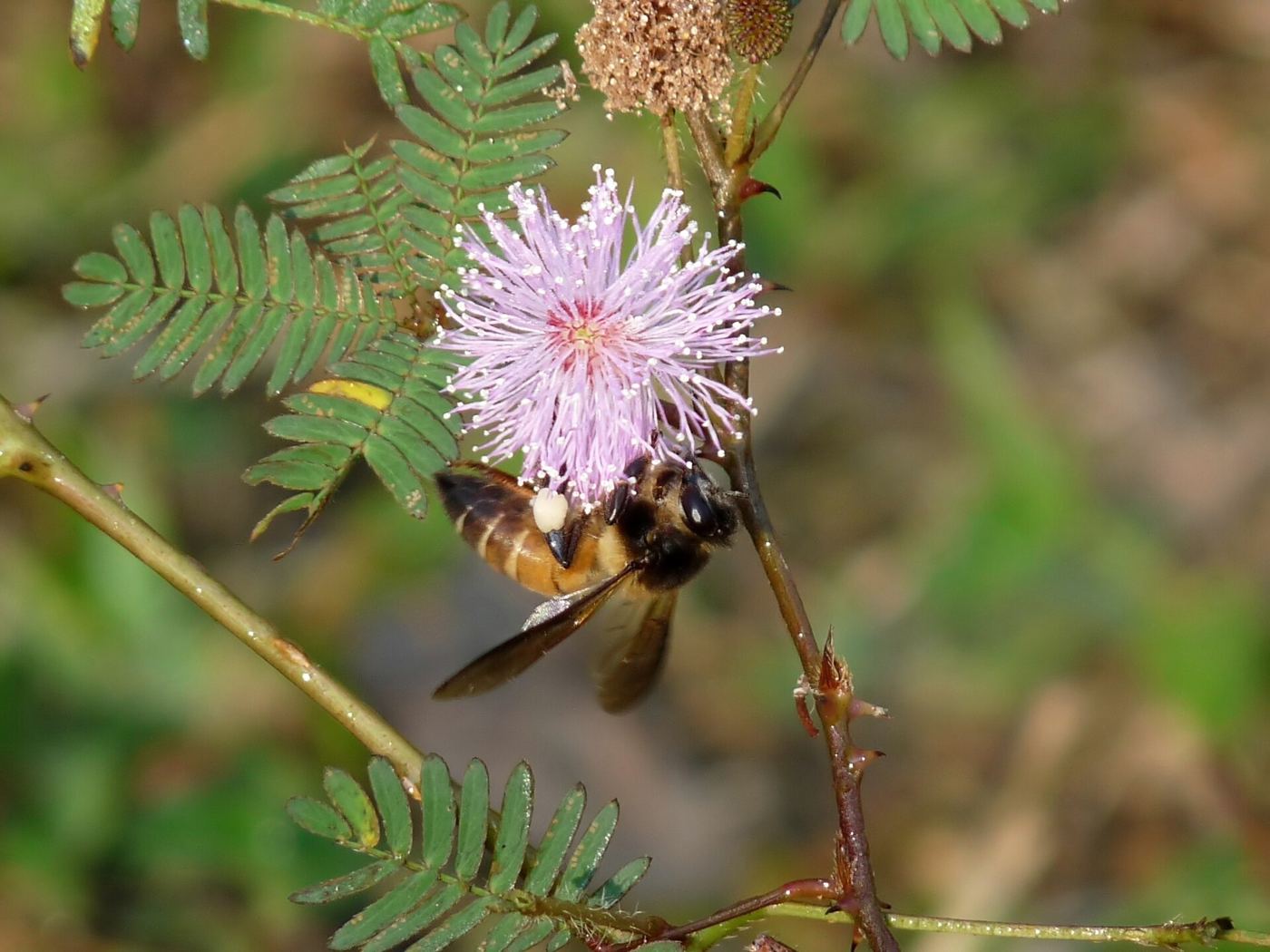
Flowers advertise themselves with colour, scent and shape, but biologists have established that they also broadcast in a channel humans cannot perceive at all: electric fields. As a bee flies, friction with the air builds a positive charge on its body, while a flower connected to the earth carries a slight negative charge, and the interaction between the two distorts the flower’s electric field in ways the insect can detect through fine hairs that bend in response. Experiments show that bees learn these electric patterns alongside colours, using them to judge which flowers they have recently visited, because a drained flower’s field changes after a visit. The discovery has widened scientists’ understanding of pollination into a sensory world of signals exchanged at close range, invisible to us yet apparently routine for the insects on which a third of food crops depend. It also raises questions about how pollution and pesticides might interfere with such delicate electrical communication.
What the Evidence Shows
Follow-up research is examining how widespread electric field sensing is among pollinators and other animals. Hoverflies, butterflies and even spiders appear to respond to electrical cues, with spiders possibly using atmospheric fields to decide when to release silk threads and balloon away on the wind. Air pollution has emerged as a serious complication: charged particles and chemical contaminants can alter floral electric fields and degrade the scent plumes insects follow, effectively jamming two signalling systems at once. Conservation biologists argue this strengthens the case for reducing pollution around farmland and wildflower habitat, beyond the direct toxicity of the chemicals involved. Engineers, characteristically, see opportunity in the biology, prototyping tiny sensors inspired by insect hairs for detecting weak electric fields in medicine and robotics. The field’s rapid growth illustrates how a curious observation, that bees and flowers exchange charge, can reorganise understanding across ecology, evolution and technology within little more than a decade of focused research attention. Reporting and analysis from sources such as National Science Foundation track the same developments, and specialists following electric field sensing by pollinating insects say the direction is now consistent across independent lines of evidence.
The Wider Context
The wider context is a research landscape in which replication and open data now decide reputations. Findings connected to electric field sensing by pollinating insects are being checked by independent groups with shared datasets, and the teams involved publish their methods in full so rivals can test every step. That discipline is slower than a headline cycle, but it is why results in this area increasingly survive first contact with scrutiny.
What Happens Next
What happens next in the story of electric field sensing by pollinating insects will be decided by follow-up work already under way: larger samples, longer observation and instruments that have not yet come online. The researchers involved are unusually united on one point, that the current results justify the next investment of time and money. Readers will not have to wait long for the first tests of that claim. You can follow related developments in our coverage of science.
There is a practical lesson in all of this for readers deciding what to do today. Start with the verified facts, be wary of anyone promising certainty, and prefer reversible steps while the evidence is still developing. Circumstances differ by country, income and personal situation, so general guidance should always be weighed against your own context before you act on it in any significant or lasting way.
